
Learn
What Is Pony Play in BDSM?
Pony play can hold elegance, service, discipline, presentation and the relief of inhabiting a role. The equipment is optional. The adult agreement is not.
Last reviewed:
In short
What is pony play in BDSM?
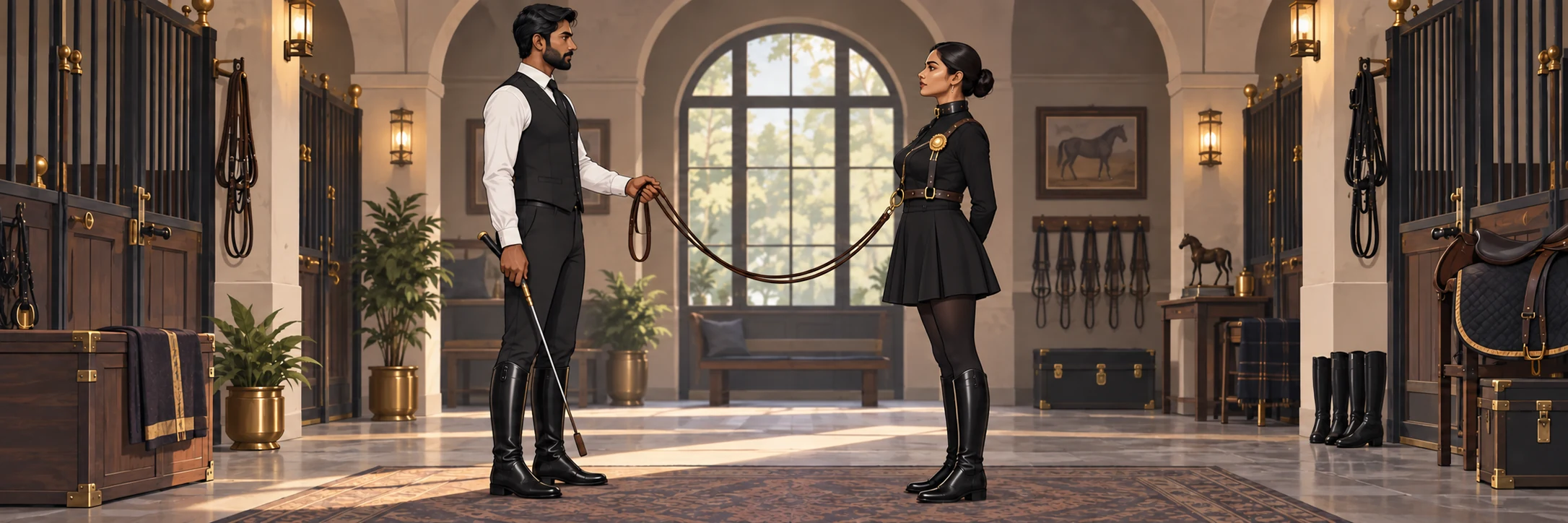
Pony play is consensual adult equine-inspired roleplay or headspace within kink or BDSM. One adult may take a pony role while another may use a community label such as handler, trainer, owner, rider or driver; usage varies, and no title creates automatic authority. The experience may centre presentation, service, discipline, identity, performance, community, dominance and submission, or simply imaginative play. It is not automatically sexual or submissive, and it never involves actual animals. Pony play sits within the wider pet-play family but has a distinct equine vocabulary and user intent, so it is explained separately from puppy or pup play. From my dominant perspective, the leading role owes the pony patience, clarity and care. I will not turn that responsibility into training, gait, load-bearing, restraint-fitting or endurance instructions here.
Perhaps it is the elegance that catches you: the held posture, the attentive quiet, the fantasy of being guided with exquisite precision. You can understand that pull without buying a harness or proving anything with your body.
Pony play: the simple definition
- Pony play
- A consensual adult role, persona or headspace inspired by ponies or horses. It may overlap with D/s, service or community identity, but none is automatic.
How pony play relates to pet play
Pet play is the umbrella for animal-inspired adult roles and headspace. Puppy play often emphasises canine imagery and playfulness; pony play uses equine imagery and may emphasise presentation, structure or performance. The overlap is real, but the terms are not synonyms.
Common pony-play roles and terms
| Term | Possible meaning | Important limit |
|---|---|---|
| Pony | The adult taking an equine-inspired role | Not automatically submissive |
| Handler / trainer | A guiding or caring role | No authority without agreement |
| Owner | Consensual ownership language | Never literal ownership |
| Rider / driver | Community role imagery | This page gives no load-bearing instruction |
What “pony headspace” can mean
Headspace can mean attention settling into the role: elegance, alertness, service, movement, presentation or relief from ordinary self-consciousness. It is personal and not a neurological state, diagnosis or therapy. The adult remains able to communicate and stop.
Why some adults may enjoy pony play
The appeal may be disciplined structure, visual symbolism, pride in presentation, service, transformation, community or the intimacy of being guided. Some enjoy equipment; others need only language and imagination. No single motivation defines the practice.
Pony play does not automatically mean submission
A pony may be submissive, dominant, switch or outside a power-exchange identity. Roleplay imagery does not assign hierarchy. Read types of submissives without using it to place every pony in a box.
Leading roles are not automatic authority
A handler or trainer title has meaning only inside an agreement. Healthy power exchange requires scope, and a Dom/sub relationship is a separate structure.
Equipment is optional context, not the definition
You may see collars, reins, harnesses or other equine-inspired props in community imagery. They are symbols and equipment, not a membership requirement. This page does not explain fitting, restraint, carrying weight, movement drills or purchases.
What I think the leading role owes the pony
I would owe them attention to the human being inside the beautiful role. If posture, speech or equipment changes communication, I must make the stop path clearer, not more theatrical. Precision without care is merely performance.
Consent and boundaries in pony play
Common misconceptions
Pony play is not about actual animals, not automatically sexual, not limited to women, not necessarily submissive and not defined by expensive gear. Community labels are descriptive, not a scientific taxonomy.
India / Delhi context
Questions to ask yourself before exploring the concept
Questions to sit with
- Is the pull about elegance, service, structure, identity, performance or care?
- Do you want D/s authority or roleplay without hierarchy?
- Which role labels feel right, and what do they mean to you?
- What equipment is unnecessary for the feeling you want?
- How will you stop, communicate and return to ordinary life?
Where pony play fits in the wider Grayside map
Start with BDSM for beginners, BDSM roles and fantasy versus real life. Then compare pet and puppy play without merging their meanings.
Pony play can be elegant, playful, service-oriented, or centred on a temporary headspace; it does not make a person less adult or less able to speak for themselves. A handler or trainer holds the frame with patience, clear boundaries, and a gentle return to ordinary life. Privacy matters when shared homes leave little room for visible symbols or equipment.
The role can be as light or as meaningful as the adults involved choose. You may enjoy a name, a mood, a brief presentation ritual, or the sense of being carefully guided. Another person may find the equine imagery helps them set aside everyday self-consciousness and focus on service or pride. Neither experience is more authentic because it uses more gear, lasts longer, or looks more dramatic online. Community terms are invitations to conversation, not ranks that someone else can award. If “pony,” “handler,” or “trainer” feels useful, define it together. If a word feels awkward, leave it behind. The role should make the people inside it feel more present, not trapped by somebody else’s idea of what it must be.
A good leading partner pays attention to transitions. Role language, a collar, a harness, or a held position can make an atmosphere feel wonderfully absorbing, but that absorption should never make it harder to communicate. Agree how to pause, what words or gestures remain available, who may be present, and whether photographs are welcome. Be candid about tiredness, discomfort, embarrassment, and privacy. If the interest includes physical activity or equipment, do not improvise from a written definition; seek qualified practical education and keep the scope conservative. This page is deliberately about meaning and consent, because the human being wearing the role matters more than the visual effect.
Pony play also does not settle the question of relationship structure. A person can enjoy an equine-inspired persona without wanting a 24/7 hierarchy, ownership language, or service outside a scene. A dominant or switch may take the pony role; a submissive may prefer no animal role at all. You can combine the imagery with a collar, protocols, or a D/s relationship only when that combination is negotiated, and you can remove any part of it later. Treat each element as its own choice. This keeps the fantasy spacious: you can be drawn to anticipation, elegance, surrender, authority, or care without signing away your ordinary autonomy.
In a Delhi or Indian home, discretion may shape what feels practical. Shared rooms, visiting relatives, apartment deliveries, and family accounts can make visible equipment or stored photographs a poor fit. That does not make the interest less real. A private conversation, a chosen title, a short ritual, or a carefully held scene may carry plenty of emotional weight. Discuss storage, notifications, images, and who can enter the room before you create a vulnerable moment. The strongest frame is one that lets you relax, knowing that your privacy and your right to stop are protected as carefully as the fantasy itself.
You do not need to understand every community term before you can explore the idea respectfully. Some adults speak of ponies, handlers, trainers, owners, riders, or drivers; others use only the words that feel natural in their own relationship. These labels are variable conventions, not official ranks and not instructions. Ask what a word means to the person using it. If it carries ownership language, decide whether that language is welcome only inside a scene, in private messages, or not at all. The human agreement is always more important than the borrowed vocabulary. A beautiful name should make you feel recognised, never make it harder to say that something does not fit.
The emotional appeal can be surprisingly varied. You may be drawn to the composed attention of a pony role, to the tenderness of being cared for, to the pride of service, or to a little teasing formality. You may be more interested in leading with patience than in taking the role yourself. You may simply enjoy the image and never want it enacted. Give yourself permission to distinguish fantasy from a practical plan. There is no requirement to buy equipment, attend an event, adopt a permanent persona, or make your interest visible. A role can be a passing daydream, a private ritual, or a meaningful part of a relationship, and each possibility deserves the same adult consent.
When you negotiate a shared moment, keep the request simple enough that both people can answer honestly. What name is wanted? Is the tone playful, formal, romantic, or service-oriented? Does the role include a collar, a position, a task, or only language? Who may know about it? What brings the role to a close? These questions turn vague excitement into a frame that can feel safe and teasing rather than confusing. If a request involves restraint, exertion, or unfamiliar equipment, pause rather than treating enthusiasm as expertise. Seek qualified practical education for physical matters and make a conservative decision. No fantasy is improved by pretending that the body has no limits.
A leading role carries a responsibility to notice the person, not just the presentation. If you are the handler or trainer in an agreed scene, you can make room for water, rest, a change of mind, ordinary speech, and a gentle return. You can ask whether the role still feels affirming, whether a command landed well, and whether privacy needs have changed. If you are in the pony role, you can name what helps you settle and what makes you feel self-conscious or unsafe. Submission does not mean becoming unreadable. The strongest sense of surrender often arrives when you know your words will be received without breaking the atmosphere.
It can help to revisit the experience after the role has ended. You might discover that you preferred the ritual to the imagery, the care to the hierarchy, or the anticipation to any visible symbol. Your partner may learn that a certain word, posture, or expectation does not feel right after all. Treat that information as useful, not as a failure of character. Roles evolve because people learn about themselves. A calm conversation after a scene lets the next one become more accurate, more private, and more emotionally satisfying. That is a far better measure of connection than how convincingly either person matched an online picture.
You can keep that conversation tender and direct. Ask what made the role feel expansive, what felt merely decorative, and whether the return to ordinary life was clear enough. If you want to explore again, choose only the parts that still feel welcome. If you do not, nothing has been wasted; you have learned something precise about your desire. A considerate partner will value that clarity over a performance. In any hierarchy, the most meaningful service and surrender remain voluntary, informed, and connected to the adult who is choosing them.
You are allowed to keep the concept entirely in imagination while you learn what the role means to you. Curiosity is already real; equipment and performance are optional.
Let elegance come from attention and agreement, not strain. The most convincing role is one you can leave safely and want to return to.
Want to introduce yourself privately?
If something on this page felt like you, you can write to me directly. Connect is a private introduction to the Delhi-based Dominant behind this site, not a public dating app, paid service or reader-to-reader matching platform.
Sources
Consent Culture — Pony Play
Supports: Current community-education orientation to pony, handler and trainer vocabulary; operational details are not reproduced.
cPony — Ponyplay FAQ2025-01-12
Supports: Independent, long-running community source showing varied pony-play terminology and meanings; coercive framing and how-to material are excluded.
National Coalition for Sexual Freedom — Consent Counts: Statement and glossary
Supports: Consent, negotiation, D/s and scene terminology used as a baseline across this batch.